At the end of every semester I evaluate myself, and I always find that I have grown in some way. This semester I feel I have grown and gain a lot from all my education classes, even if my grades do not reflect it. In language arts I feel that through reading Sahara Special I have learned the impact of teachers in general and how big the role we play actually is. I also learned that I take for granted two important things: talk and listening. I must make sure to teach this in my class and not assume that my students already know this.
Creating this blog was beneficial to me, I suppose. I felt is a real pain to be told what to address, and found it hard to just address it, while making it interesting. I feel just keeping a regular blog would be easier and I may take the time to do it at some point. I do think I will have a blog or website for my classroom one day, where parents can log on and see what is going on in the classroom and what the homework of the week is.
Tuesday, April 28, 2009


Friday, April 24, 2009
What is talk?
Talk is another topic we take for granted in classes just like listening. Talk isn't just verbal it can be anything that is considered a conversation.
In class we found a new way of talking like "magic talk". "Magic talk" is when the teacher or anyone writes a word, phrase, or sentence on the board and then people participating stem from that word, phrase, or sentence. I never knew about this form of talk; I cannot believe I went through 15 years of school without this. It was an awesome form of talk that can be seen and more than one person can "talk" at a time. This will be implemented at least once a week in my future classroom.
Another form of talk I like is virtual talk. Virtual talk can be blogs like this, emails, social networking sites, or even discussion boards. It is a good way to keep in touch with friends, family, and have educational conversations from a distance. It is a good way to get input for writing papers, researching, and answering questions without ever having to verbally talk to someone.
After viewing the clip from Freedom Writers in class on Monday I was reminded how powerful the words and discussion a teacher has with her students. Talk is a powerful tool whether it's through verbal talk like Freedom Writers, magic talk like our class discussion, virtual talk like this web journal or written talk. Talk one of the most valuable tools in the classroom, and one of the most looked over tools too.
In class we found a new way of talking like "magic talk". "Magic talk" is when the teacher or anyone writes a word, phrase, or sentence on the board and then people participating stem from that word, phrase, or sentence. I never knew about this form of talk; I cannot believe I went through 15 years of school without this. It was an awesome form of talk that can be seen and more than one person can "talk" at a time. This will be implemented at least once a week in my future classroom.
Another form of talk I like is virtual talk. Virtual talk can be blogs like this, emails, social networking sites, or even discussion boards. It is a good way to keep in touch with friends, family, and have educational conversations from a distance. It is a good way to get input for writing papers, researching, and answering questions without ever having to verbally talk to someone.
After viewing the clip from Freedom Writers in class on Monday I was reminded how powerful the words and discussion a teacher has with her students. Talk is a powerful tool whether it's through verbal talk like Freedom Writers, magic talk like our class discussion, virtual talk like this web journal or written talk. Talk one of the most valuable tools in the classroom, and one of the most looked over tools too.
Friday, April 17, 2009

Monday, April 13, 2009
I can see clearly now
Until my eyes were open in Language Arts education I took teaching listening forgranted. I never realized how important it was to teach listening. Most teachers just assume that stundents know how to listen. I feel like a lot of teachers that I have observed alone take teaching listening forgranted. I guess teachers and future teachers, like myself, assumpe that because we can hear we are listening and absorbing.
Another thing that teachers need to be aware of is propaganda and persuasion. Students are influenced everyday be commericials on televison. If we aren't teaching them about politics and educating them about what propaganda is then a lot of students are going to be persuaded by the propaganda on television. This is a problem when they become adults because of political ads. If they just believe these ads without researching the facts then they will may vote in ways that would not benefit our country.
Teachers are so important and I became more aware of this week when my education class begin to discuss listening and propaganda.
Another thing that teachers need to be aware of is propaganda and persuasion. Students are influenced everyday be commericials on televison. If we aren't teaching them about politics and educating them about what propaganda is then a lot of students are going to be persuaded by the propaganda on television. This is a problem when they become adults because of political ads. If they just believe these ads without researching the facts then they will may vote in ways that would not benefit our country.
Teachers are so important and I became more aware of this week when my education class begin to discuss listening and propaganda.
Friday, April 3, 2009
Watch and learn
The best observation I have experienced this semester was book shopping. When I initially heard the students were about to shop for books I immediately assumed the book fair was at the school, but to my surprise the class "shopped" for books in the classroom. The teacher had organized the books in three different bins which were according to reading levels. The students were then called on and told what bin to pick from. The students selected 6 books: 3 to take home, 3 to put in their reading own reading bin (for read & relax time). At the end of the week the students would switch and take the three books at home to school and the three books at school home and then the cycle began again. Each book had an index card in the back and the student had to remove it put their name and date on the card. After that the index card went into a pocket with their name on it.
I really liked this book shopping idea, the students seemed to really like it and get excited about it. I believe whenever you can get a child excited about reading then you have succeeded as a teacher.
I really liked this book shopping idea, the students seemed to really like it and get excited about it. I believe whenever you can get a child excited about reading then you have succeeded as a teacher.
Today, I feel like a teacher
Last night my brother, who is a fifth grade teacher, my sister-in-law, and I were all discussing schools. We were talking about special educations, benefits and cons of home-school, public school, private school, and charter schools. Our discussion expanded into an hour long discussion.
Today I thought about how fun it was talking about a passion I have and how deep our conversation had expanded. This is when I realized how much I have grown in the past two years, I am well on my way down the road of teaching. Today, I really began to feel like a I was blossoming into a teacher.
Today I thought about how fun it was talking about a passion I have and how deep our conversation had expanded. This is when I realized how much I have grown in the past two years, I am well on my way down the road of teaching. Today, I really began to feel like a I was blossoming into a teacher.
Friday, March 27, 2009
Pout pout fish (:
Dr. Duncan introduced the cutest book to me recently called, Pout Pout Fish and I really intend on using it my classroom because it teaches how pessimistic attitudes affect your life and your relationships negatively. The pessimistic pout pout fish transforms into an optimistic kiss kiss fish at the end of the book because he gets kissed. In my classroom I could ask the students why they thought the fish changed and why. Were they glad he changed? Then I would get them write about a time that they changed. I feel this lesson would be a literature focus, but it could shift into and thematic unit about emotions. I could use a lot more books to introduce different emotions and divide the class in groups with books to make a poster about the emotion presented in their book.
Friday, March 20, 2009
Test fears
This week in class we took our midterm and my worst nightmares came true...I hate brain stinks! I hate tests... I study and study then as soon as I get the test the information decides to leave me. I don't understand why. I was taking the test in class and questions I HAD JUST REVIEWED not even 10 minutes prior to recieving the test would not come to me. I wonder how I can test my students' knowledge in the future without written test or without making them stress over big tests. Are test really a good measurement of knowledge? Are written test the only way to go?
Wednesday, March 11, 2009
What grade to teach, that is the question
All though subbing high school has taken me out of "the land of the little people" (as Dr. Duncan says) it has also taught me to appreciate teaching on all levels. As I was observing this week at Partnership Elementary, I learned that I think I want to get licensed in k-12.
At Partnership Elementary I get side tracked every time I observe because the entire first grade is divided up into four sections in one big long room. I can hear the other teachers teaching and it gets so distracting. The kids and the teacher I am observing don't seem to notice. I really wonder how the teachers overcame this problem at the beginning of the year (this is going to be my first question of the teacher interview).
So now that I am all mixed up on what grade I want to teach, I think I will go sub in a middle school (:, if only they will call me.
Again I encourage all future teachers to sub, tutor, and observe as many as grades as possible.
(: Have a great day!
At Partnership Elementary I get side tracked every time I observe because the entire first grade is divided up into four sections in one big long room. I can hear the other teachers teaching and it gets so distracting. The kids and the teacher I am observing don't seem to notice. I really wonder how the teachers overcame this problem at the beginning of the year (this is going to be my first question of the teacher interview).
So now that I am all mixed up on what grade I want to teach, I think I will go sub in a middle school (:, if only they will call me.
Again I encourage all future teachers to sub, tutor, and observe as many as grades as possible.
(: Have a great day!
Tuesday, March 3, 2009
Snow on Spring Break
So what is up with snowing on my spring break? Its snowing in my world today too!I want to teach elementary students but I am subbing for high school students. This was a neat experience, since I am use to little kids and these students are only like 4 years younger than me. It was a neat experience and I really enjoyed it. I just wanted to share with future teachers (like me) that it's a great idea to sub and try all grades...you may just change your mind :)
Friday, February 20, 2009
The Sloppy Copy
This week was interesting in class; we discussed writing, and focused on prewriting. When I was in elementary school my teachers stressed the importance of prewriting. We always would have to brainstorm for ten minutes before we could begin a first draft. The first draft was always referred to “sloppy copy” (which I learned was not a good idea, because this phrase makes it seem like the first draft is not important). Everyone in my class would rush through the “sloppy copy” so we could type our final draft. My class also had a word wall with words we were learning, and a “make it beautiful wall”. The “make it beautiful wall” was full of adjectives and we were required to use at least ten words from the wall to make our papers “beautiful”.
Having a blog has made me concerned about my writing and thinking about what I say before I type, and definitely has made me aware of the importance of proofreading. I am not sure I like the blog yet, I do not really like having to make sure I write on it once a week, I think I would like the blog more if it wasn’t graded and I could just write about my experiences with my tutoring or something like that. Although I don’t really like having to write on it, I see the importance of it because it makes me reflect on class (Meredith College is REALLY BIG on reflecting) and on my past experiences. So although I don’t “LOVE” the blog, I know it is really important.
My opinions have of writing have really changed this semester about the “sloppy copy”. By being referred to as sloppy copy in school it made me rush to finish it, therefore, when I write papers now, I don’t plan, I rush through my sloppy copy, proofread, fix, and I am done. If my teachers had referred to it my best first draft I might not be this way now. I feel the context we use when referring to something can really affect our students’ future
A project we are beginning is the book project I really think my book will include my experience of leaving home and going to college but I am not a 100% sure yet, it might be about when I found out my dad had cancer, or it could be a mix of it all my senior year of high school losing my band director to sleep apnea, my brother attempting suicide and then finding out about daddy’s cancer then having to leave home. I am not sure I want to do the last topic yet because I am still dealing with it in a way and I am not sure I am ready to confront that yet.
Having a blog has made me concerned about my writing and thinking about what I say before I type, and definitely has made me aware of the importance of proofreading. I am not sure I like the blog yet, I do not really like having to make sure I write on it once a week, I think I would like the blog more if it wasn’t graded and I could just write about my experiences with my tutoring or something like that. Although I don’t really like having to write on it, I see the importance of it because it makes me reflect on class (Meredith College is REALLY BIG on reflecting) and on my past experiences. So although I don’t “LOVE” the blog, I know it is really important.
My opinions have of writing have really changed this semester about the “sloppy copy”. By being referred to as sloppy copy in school it made me rush to finish it, therefore, when I write papers now, I don’t plan, I rush through my sloppy copy, proofread, fix, and I am done. If my teachers had referred to it my best first draft I might not be this way now. I feel the context we use when referring to something can really affect our students’ future
A project we are beginning is the book project I really think my book will include my experience of leaving home and going to college but I am not a 100% sure yet, it might be about when I found out my dad had cancer, or it could be a mix of it all my senior year of high school losing my band director to sleep apnea, my brother attempting suicide and then finding out about daddy’s cancer then having to leave home. I am not sure I want to do the last topic yet because I am still dealing with it in a way and I am not sure I am ready to confront that yet.
Friday, February 13, 2009
Can reading and writing disablities have an effect on social life?
Having a disability or delay in either reading or writing can have a big affect on one’s social life. One reason is because reading is the greatest way to build one’s vocabulary, if you have a delay in reading it can be quiet difficult building your vocabulary. If your vocabulary isn’t strong it could be hard to gain social skills. Another way that reading and writing can have an effect on social skills, that happens most often in school systems is the child’s confidence. It is really hard to obtain confidence in school if you aren’t reading or writing well, and also the other students might see you as dumb. I know from experience in school because I was a great reader and writer, but the not everyone in my class was. It really bugged me when my peers struggled in reading because I didn’t understand some people could have a disability or delay. I thought the students that got pulled out of class weren’t smart. Now that I look back I feel guilty for thinking that. I am majoring in psychology so I am really being to learn that students with delays and disabilities just learn differently than the average student.
In class (Educational Language Arts) we are reading a book about a little girl name, Sahara, who is having trouble with social skills and cues. We have not yet learned if she has a disability , we just know she does not do her work because she knows it will go in her "folder" whether she does a good job or not. (the folder is probably her IEP) We do know she loves to write and she is writing a "novel" and keeping the novel in the library.
As a teacher I really want to encourage kids not to be embarrassed if they aren’t the best readers or writers. If children are snickering at the struggling student, I plan to start a mini-lesson right then on respecting our peers. I plan to reveal that everyone is different and learns differently. Some people are super at academics while others are good at athletics ect.
Friday, February 6, 2009
Looking back into !995
It's August 1995 and I prance into Mrs. Bolt's classroom in a little pink dress with blue kitty cats on it; its the day that I begin to learn the complex language of English. To start with we learn the how the ABC's sound, we already knew our ABC's. Each day for 26 days we learned the sound of a new letter; each letter was printed on these long rectangular cards (portrait way) in upper case, lower case and with the pronunciation at the bottom. Behind the text was a picture that began with the letter that it was representing. For example the "A" card had an apple depicted in the background.
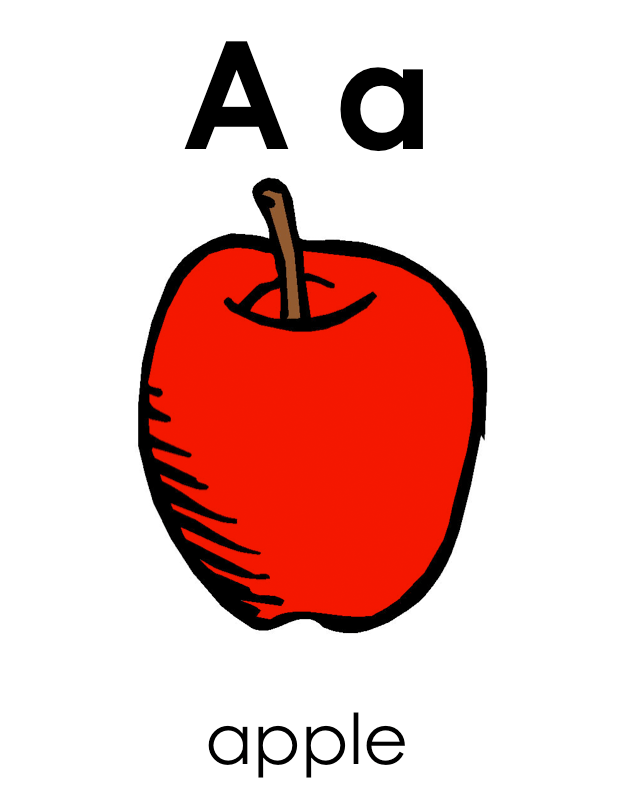 (this little apple is the closest picture I could get to help you visualize what I was seeing as a 5 year old)
The phonics is how I begin to learn the proper way to pronounce words, and as each grade progressed I was learning how to read words by sounding them out and then spelling by sounding it out. Finally I get to middle school and "BAMM" I am hit with grammar. In six grade I begin to learn how to diagram a sentence and that there are things like past participles, verb tenses, and adverbs; it's not just nouns, verbs, and adjectives. And you know what else I discovered in six grade...a noun is not just a person, place, or thing it can be an idea too. O my gracious the English language just keep getting more complex, and it has continued through my lessons at Meredith College, I am still learning new things about the English language.
I suppose I really begin learning/ discovering language when I was a baby through my parents saying word and me gradually learn to repeat them until I could formulate sentences that made sense from that moment I begin adding onto the scaffolding my parents provided at those very crucial early years.


My previous years of learning experiences have really impacted me today as a student learner. As much as I hate to say it I feel that I did not have the strongest elementary teachers which as resulted in me not being the brightest in the grammar area because I struggle in many areas like subject-verb agreement and commas. My elementary teachers were brilliant in teaching me to read, but really lacked in the area of grammar. This as really impacted me as a student learner because I struggle in producing professional papers for my education teachers, and lets not even mention the English department. Because of this I want to strive to soak up all I can in college, which means using all my resources such as the learning center, so I can be a elementary teacher that teachers her students proper grammar that can stick with them forever. Because my elementary and high school years didn't prepare me for as much as I would have liked for college it just means I have work extra hard in college to be a super teacher in the future. I know I will not be perfect and I will never fully master grammar, but I know will master good enough to teach my future students to succe in their futures.
If any parents are reading this I challenge you to challenge your child's teachers. Read every letter they send home, make sure they write well because they are teaching your students and if they are mastering areas then how will they be effective in teaching your childern, our future leaders?
Saturday, January 31, 2009
The Reading Process
During class on Monday we learned the difference between aesthetic and efferent readings. An aesthetic reader reads for pleasure and has an emotional response where as an efferent reader focuses on the information shared. I am basically for now an efferent reader; I read because I have to learn and boy has college given me a bunch of books to read for information. I use to be an aesthetic reader, but college has taken the place for that for now. I hope upon completing college I will be able to read for pleasure, aesthetically, again.
Today I learned valuable information to use in my future years of teaching. I learned that there are five stages of reading process which are:
Today I learned valuable information to use in my future years of teaching. I learned that there are five stages of reading process which are:
- Pre-Reading: learning background information to better understand the book before even reading it. For example: A Meredith student who associates with MeredithReads does an activity with the student/s she is working that introduces the book she is going to read.
- Reading: obiviously actually reading the book. For example: The Meredith girl reads the book to the child.
- Responding: getting the child to respond about the book. For example: The Meredith girl asks the child questions about the book they just shared.
- Exploring: going deeper than just the words on the pages, acutally understanding what the book was about. For example: The Meredith Angel and her student do an activity that further inforces the lesson the child was suppose to gain from the book.
- Applying: Create project so the child can further learn from the book. For example: The Meredith Angel sends home a letter with child, so the child and their parents can work together and do activities so the student can further expand thier knowledge of the book.
- Word Identificaiton: site words/high frequency words *Phonics*
- Fluency: Reading speed, word recogniation, *Prosody* (knowing how to read/expression)
- Vocabbulary: what the most beneficial way to expand vocabulary- to READ more and more
- Comprehension: use strategies before, during, and after reading.
Tuesday, January 13, 2009
The Six Language Arts
I was surprised that viewing was a part of the 6 language arts, I would have never guessed that. It was neat to learn that there were 3 types of listening . I feel that viewing and visually representing are important to the 6 language arts, especially after reading their descriptions. By adding this, of course we as educators are condoning the digital and media influences on children's lives but digital and media is going to influence children regardless; so why not use digital and media in a positive and learning manner.
I have experienced with all of the language arts personally when I was in school, but what stands out the most is visually representing. In most of my language arts classes in middle and high school after completing a novel we would have to do art projects that visually represent what we read or what we got from what we were reading. I have always had a strong passion for language arts learning and it grows stronger every day with the more I learn about it. I expect it to always be the same too, because knowledge on this subjects makes the fire of passion for language arts burn stronger.
I really enjoyed Sahara Special, it was so realistic. I could see this happening in any school in fact I am sure it has happened in every school. I feel that I could learn a lot about becoming a future educator from this book, and I know hearing this from a child's perspective will make me an even better teacher. I feel that Sahara is going to hold back for a while but in the end come out a conquer and show her teachers and guidance director that she can succeed and she is not a special education student.
What was your initial reaction to Sahara Special? Can you relate to this story so far? Any predictions for what is to come?
I have experienced with all of the language arts personally when I was in school, but what stands out the most is visually representing. In most of my language arts classes in middle and high school after completing a novel we would have to do art projects that visually represent what we read or what we got from what we were reading. I have always had a strong passion for language arts learning and it grows stronger every day with the more I learn about it. I expect it to always be the same too, because knowledge on this subjects makes the fire of passion for language arts burn stronger.
I really enjoyed Sahara Special, it was so realistic. I could see this happening in any school in fact I am sure it has happened in every school. I feel that I could learn a lot about becoming a future educator from this book, and I know hearing this from a child's perspective will make me an even better teacher. I feel that Sahara is going to hold back for a while but in the end come out a conquer and show her teachers and guidance director that she can succeed and she is not a special education student.
What was your initial reaction to Sahara Special? Can you relate to this story so far? Any predictions for what is to come?
Subscribe to:
Posts (Atom)